
In contrast to other dinosaurs that were either crushing their prey’s bones with powerful jaws or slowly munching on leaves and branches, Infernogallus jamesi might have been joyfully enjoying the sweetness of nature.
This recently identified species — whose name means “hell chicken” — possessed a beak devoid of teeth and a jaw structure indicating a diet primarily composed of fruits, as stated in a study published in Nature Communications.
According to Greg Funston, the lead author of the study, “This dinosaur was something of a revelation for us, as we long believed dinosaurs did not consume fruits,” he explained to As It Happens host Nil Köksal.
If the authors of the study are indeed correct, this would classify the hell chicken as the first known dinosaur that primarily consumed fruit. However, some scientists advise that additional evidence is necessary to validate this theory.
‘Possibly quite aggressive’
Infernogallus jamesi was a dinosaur comparable in size to a turkey, existing approximately 66 million years ago, cohabiting the Earth with Tyrannosaurus rex and Triceratops.
Belonging to the Caenagnathid family, this group of dinosaur species had elongated beaks and feathered bodies. Funston likened it to a mix between an emu and a parrot, asserting that it was “probably quite aggressive in temperament.”
“Most individuals wouldn’t want to be in a cage with a turkey,” noted Funston, an assistant professor at Stony Brook University in New York. “But its name isn’t derived from its temperament or behavior.”

The hell chicken’s name, instead, originates from the Hell Creek Formation, where its fossil was discovered in 2011. This area is currently a rugged region covering a significant portion of the western U.S. and parts of Canada. However, during the Cretaceous period, it was a verdant forest teeming with prehistoric life.
The discovery is noteworthy due to the rarity of complete Caenagnathid fossils, explains paleontologist and author Riley Black, who was not part of the study.
-
Jerky-like skin of a 52,000-year-old woolly mammoth could change what we know about ancient DNA
-
Prehistoric puke reveals hunting (and hurling) habits of ancient ocean predators
“I have been anticipating a fossil like Infernogallus for quite some time,” Black said in an email.
“Infernogallus provides our first glimpse into what a caenagnathid skeleton truly resembled in life, and, even more intriguingly, it is so unusual that paleontologists may need to reevaluate the lifestyle of these dinosaurs.”
A beak without teeth and a jaw resembling that of humans
According to Funston, what is peculiar about the hell chicken’s skeleton is its jaw structure.
He noted that most dinosaurs had jaws that moved “up and down.” This movement allowed carnivorous species to exert the necessary force to consume their prey, while herbivores could easily grind through plants, ferns, leaves, and branches.
However, that was not the case for the hell chicken.
“Rather than moving the jaws up and down, the muscles instead would pull the jaws forwards and backwards. This is a motion familiar to us, similar to how we chew,” he explained.
“This animal was processing something relatively soft that required considerable manipulation before swallowing. To us, it seems that only one type of food fits this description, and that is fruit.”
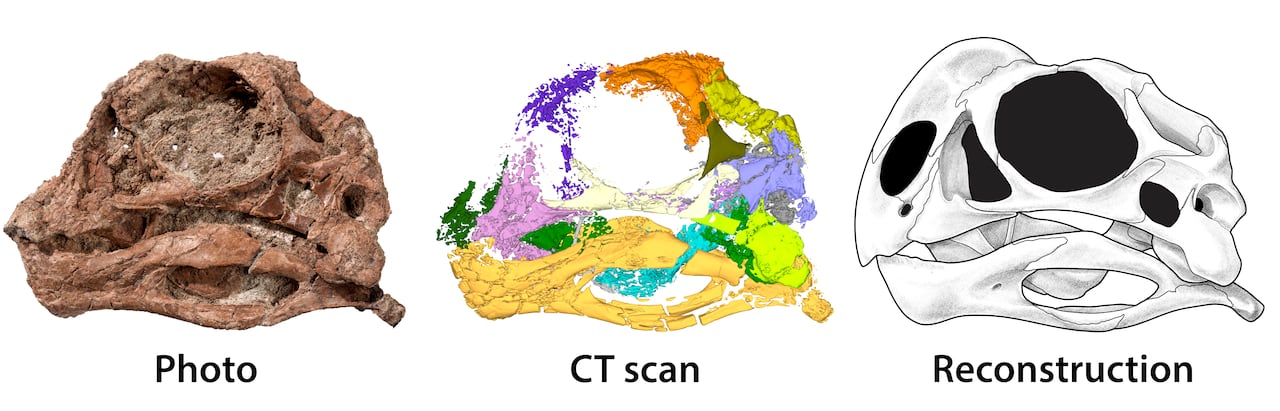
Researchers analyzed, scanned, and reconstructed the skull of Infernogallus jamesi, also known as the ‘hell chicken.’ (Submitted by Greg Funston)
If their assumptions are accurate, it could resolve a long-standing mystery among paleontologists, he states.
Around 130 million years ago, flowering plants began to proliferate on Earth, supplanting the cone-bearing species that came before and offering an abundance of fruit for animals.
Birds, which are classified as dinosaurs, were the first to adopt fruits. Research indicates they have been consuming fruits for at least 120 million years.
However, until now, there has been minimal evidence to suggest that non-avian dinosaurs relied on fruits as a staple in their diets.
“For an extended period, we struggled to understand how dinosaur evolution corresponded with this significant shift,” Funston remarked.
Evidence ‘circumstantial,’ warns scientist
Nevertheless, Black cautions that the proof of the hell chicken being a fruit specialist is currently “circumstantial.”
“When we examine dinosaur skeletons, there is always a conflict between what a dinosaur might have done and what it actually did,” she stated.
“The beaked face of Infernogallus and its size make it clear that the dinosaur was likely plucking small bites and consuming relatively tender foods. But what exactly?”
To establish certainty, she mentions that scientists would require direct evidence of fruit in the preserved remains of the creature— a challenging task. A hell chicken would need to die shortly after consuming its meal, become fossilized, and be found mostly intact.
“Such discoveries are uncommon, often necessitating extraordinary conditions and a bit of luck,” she noted. “It is quite fortunate that we have any gut contents from dinosaurs at all.”
-
Researchers discover thousands of dinosaur footprints in Alaska
-
Scientists digitally rebuilt the brain of a 205M year-old dinosaur. Here’s what they found
Still, she emphasizes that this research is an exciting initial step.
“The study will undoubtedly inspire further investigations and discussions regarding the interactions between plants and dinosaurs,” she stated.
“In paleontology, few things provide a definitive understanding of how animals that have been extinct for millions of years actually lived. It is the questions that drive us to seek knowledge and engage in debate, which is part of what makes it so fascinating.”
