
On Friday, U.S. President Donald Trump announced the removal of tariffs on numerous food items, including essential products such as beef, tomatoes, and bananas, addressing the increasing concerns of American consumers regarding grocery prices.
The newly introduced exemptions, which will be applied retroactively from midnight Thursday, signify a notable shift for Trump, who has consistently claimed that his tariffs do not contribute to inflation.
When questioned about this decision while on Air Force One Friday evening, Trump acknowledged that “they may in some cases” increase prices due to his tariffs, but he maintained that, overall, the U.S. is experiencing “virtually no inflation.”
Democrats have recently achieved multiple victories in state and local elections across Virginia, New Jersey, and New York City, where rising concerns over affordability, particularly regarding food costs, were a significant issue.
Trump also informed reporters that he plans to proceed with a $2,000 payment to lower- and middle-income Americans, which will be funded through tariff revenues sometime in the next year.
He stated, “The tariffs allow us to give a dividend if we want to do that. Now we’re going to do a dividend, and we’re also reducing debt.”
Exemptions cover more than 200 products
On Thursday, the Trump administration revealed framework trade agreements that, once concluded, will lift tariffs on specific food items and other imports from Argentina, Ecuador, Guatemala, and El Salvador, with U.S. officials looking into additional agreements before the year’s end.
The list released on Friday features items that American consumers commonly buy for their households, many of which have experienced double-digit price hikes over the past year.
This encompasses over 200 products, including oranges, acai berries, paprika, cocoa, food production chemicals, fertilizers, and even communion wafers.
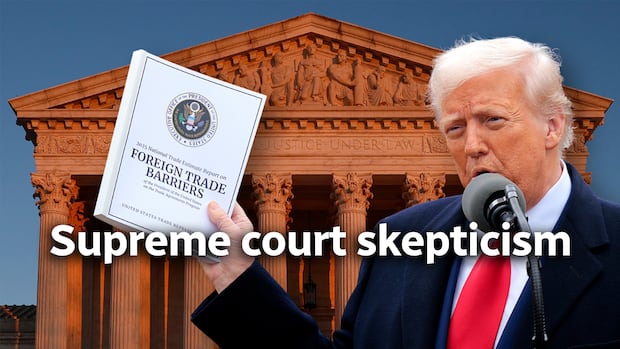
Has Congress given the U.S. president the power to impose sweeping tariffs through the International Emergency Economic Powers Act? The Supreme Court will make a decision in a ruling that could restrain the Trump administration’s primary economic and foreign policy tool. Andrew Chang breaks down the central arguments for and against President Donald Trump’s use of the statute to impose worldwide tariffs — and explains why the justices don’t seem convinced.
Images provided by The Canadian Press, Reuters and Getty Images
In a fact sheet regarding the order, the White House stated that this decision follows “significant progress the President has made in securing more reciprocal terms for our bilateral trade relationships.”
It noted that certain food items were exempted because they are not cultivated or processed in the U.S., alongside the conclusion of nine framework agreements, two final reciprocal trade agreements, and two investment arrangements.
As per the most recent data from September, ground beef prices were nearly 13 percent higher, while steaks had increased by almost 17 percent compared to the previous year.
These increases were the largest recorded in over three years, coinciding with a period when inflation was approaching its peak under Trump’s predecessor, Democrat Joe Biden.
Prices for bananas rose by around seven percent, while tomatoes saw a one percent increase. Overall, food costs for home consumption were up 2.7 percent in September.
The exemption from tariffs received approval from many industry organizations, although some expressed dissatisfaction that their products were not included in the exemptions.
FMI-Food Industry Association president Leslie Sarasin stated, “Today’s action should help consumers, whose morning cup of coffee will hopefully become more affordable, as well as U.S. manufacturers that utilize many of these products in their supply chains and production lines.”
Distilled Spirits Council president Chris Swonger criticized the exclusion of spirits from the European Union and Britain, calling it “yet another blow to the U.S. hospitality industry just as the critical holiday season kicks into high gear.”
“Scotch, cognac, and Irish whiskey are value-added agricultural products that cannot be produced in the United States,” Swonger remarked.
When asked about potential further changes, Trump responded to reporters aboard Air Force One, stating, “I don’t think it’ll be necessary.”
He added, “We just did a little bit of a rollback. The prices of coffee were a little high; now they’ll be on the low side in a very short period.”
Trump has disrupted the global trade system by enforcing 10 percent base tariffs on imports from all countries, along with additional specific and varying duties.
Concerns over rising grocery costs
Recently, the president has concentrated on the issue of affordability, while asserting that any price increases were caused by policies implemented by Biden rather than his own tariff actions.
Consumers continue to express frustration concerning high grocery prices, which economists attribute, in part, to import tariffs. They warn that prices may further escalate next year as businesses begin to transfer the full impact of the tariffs onto consumers.
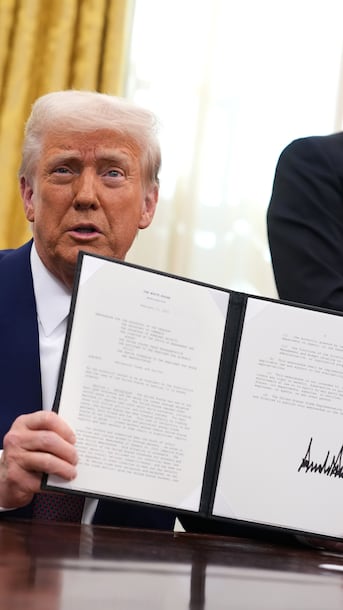
It’s been one year since U.S. President Donald Trump’s second election win. CBC’s Mike Crawley breaks down how Trump’s policies have affected the economy since his return to the White House.
Richard Neal, the leading Democrat on the House of Representatives Ways and Means Committee, stated that the Trump administration is “putting out a fire that they started and claiming it as progress.”
He added, “The Trump administration is finally acknowledging publicly what we’ve all recognized from the start: Trump’s trade war is increasing costs for the public.”
“Since these tariffs were introduced, inflation has risen and manufacturing has declined month after month.”
