
Previously, it was believed that encountering ticks was most common during the peak of summer and in areas with tall grass that could come into contact with individuals.
However, the Wellington-Dufferin-Guelph Public Health now advises people to conduct tick checks after being outdoors when the temperature is above 0 C.
Phil Wong, the health unit’s director of operations for health protection, mentioned that through a monitoring program where individuals reported their tick encounters with photos and details, they have observed ticks in locations beyond wooded trails.
He identified three primary areas where people are at risk:
- Outdoor spaces like parks, trails, and camping sites with tall grass.
- Private properties and homes where people reside.
- Work-related exposures for individuals who work outdoors.
Wong emphasized that many individuals are reporting tick encounters on their private properties while gardening or doing activities like raking leaves, even if not in tall grass.
Regarding playgrounds, Wong assured that the risk of ticks is low as ticks prefer damp areas and avoid direct sunlight. However, he recommended parents to check their children for ticks after outdoor activities near wooded areas.
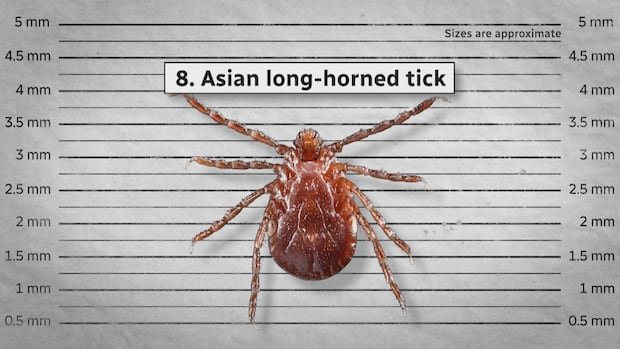
There are already 40 different types of ticks in Canada, with more species expected to migrate north. For The National, CBC’s Tom Murphy goes to the Canadian Tick Research and Innovation Centre (CTRIC) to find out more about the evolving risk.
More than 40 types of ticks in Canada
As the local tick population grows and encounters become more common, Wellington-Dufferin-Guelph Public Health has updated its tick guidance.
Experts warn that Canadians should prepare for an increasing influx of ticks from the United States.
Health Canada reports over 40 tick species in Canada, some native while others may be introduced through hosts like birds and deer.
Some ticks carry diseases, such as the Western blacklegged tick transmitting various pathogens, including Lyme disease, and the lone star tick causing meat allergies in some cases.
A new Canadian Tick Research and Innovation Centre has opened at Acadia University in Wolfville, Nova Scotia, to enhance the study of ticks and tick-borne diseases.
Additionally, the G Magnotta Lyme Disease Research Lab at the University of Guelph focuses on tick-related research.
Justin Wood, the founder of Geneticks and a Lyme disease researcher, emphasizes the importance of early diagnosis and interventions for tick-borne illnesses.
Wood highlights that ticks do not necessarily die off during cold winters but instead hibernate in leaf litter, making tick encounters a year-round concern.
