
A recent study centered around a fossil dating back 380 million years from Nunavut is raising new inquiries among scientists regarding the initial development of necks in tetrapods.
Since its discovery on Ellesmere Island twenty years ago, researchers have identified Tiktaalik roseae as the earliest known tetrapod, a four-limbed organism, showing a distinct separation between its skull and shoulders. Scientists have long speculated that this neck formation allowed the creature increased head movement as it transitioned to a terrestrial lifestyle.
Dana Korneisel, a postdoctoral researcher at Carleton University, is the principal author of the recent study released this month in the journal Nature. A team from Carleton and the University of Ottawa conducted experiments on lake sturgeon, which serve as the closest modern anatomical analog to Tiktaalik roseae.
This research also involved contributors from Penn State University and the University of Washington in the United States.
After the experiments, scientists estimated that Tiktaalik roseae could only move its neck less than six degrees side to side.
“The previous theory suggested that the formation of the anatomical neck … would coincide with an enhanced ability to bend and twist the neck and to move the head in relation to the body,” Korneisel remarked.
“What we discovered was that the range of motion was quite limited for bending, both laterally and vertically, akin to what is observed in contemporary fish.”
Hillary Maddin, a paleontologist at Carleton University and co-author of the study, indicates that these results prompt new questions and hypotheses regarding the evolution of necks.
“It may have more to do with providing a more stable and independent support for the limbs and shoulder girdle on the ground as it began adapting to terrestrial movement,” Maddin noted.
The necessity to maneuver their forelimbs
Based on the results from the lake sturgeon tests, researchers now believe that Tiktaalik roseae evolved its neck to gain better control over its front limbs. Korneisel mentions that there has been little prior research on the extent to which early tetrapods could bend or twist their necks.
She adds that the study benefited from an earlier three-dimensional reconstruction of Tiktaalik roseae’s neck area created by co-author Tom Stewart at Penn State University.
In addition to Tiktaalik roseae, the research team analyzed fossils of other ancient tetrapods to derive neck measurements, which were then utilized in conjunction with the backbone of a modern sturgeon using a universal testing machine at the University of Ottawa.
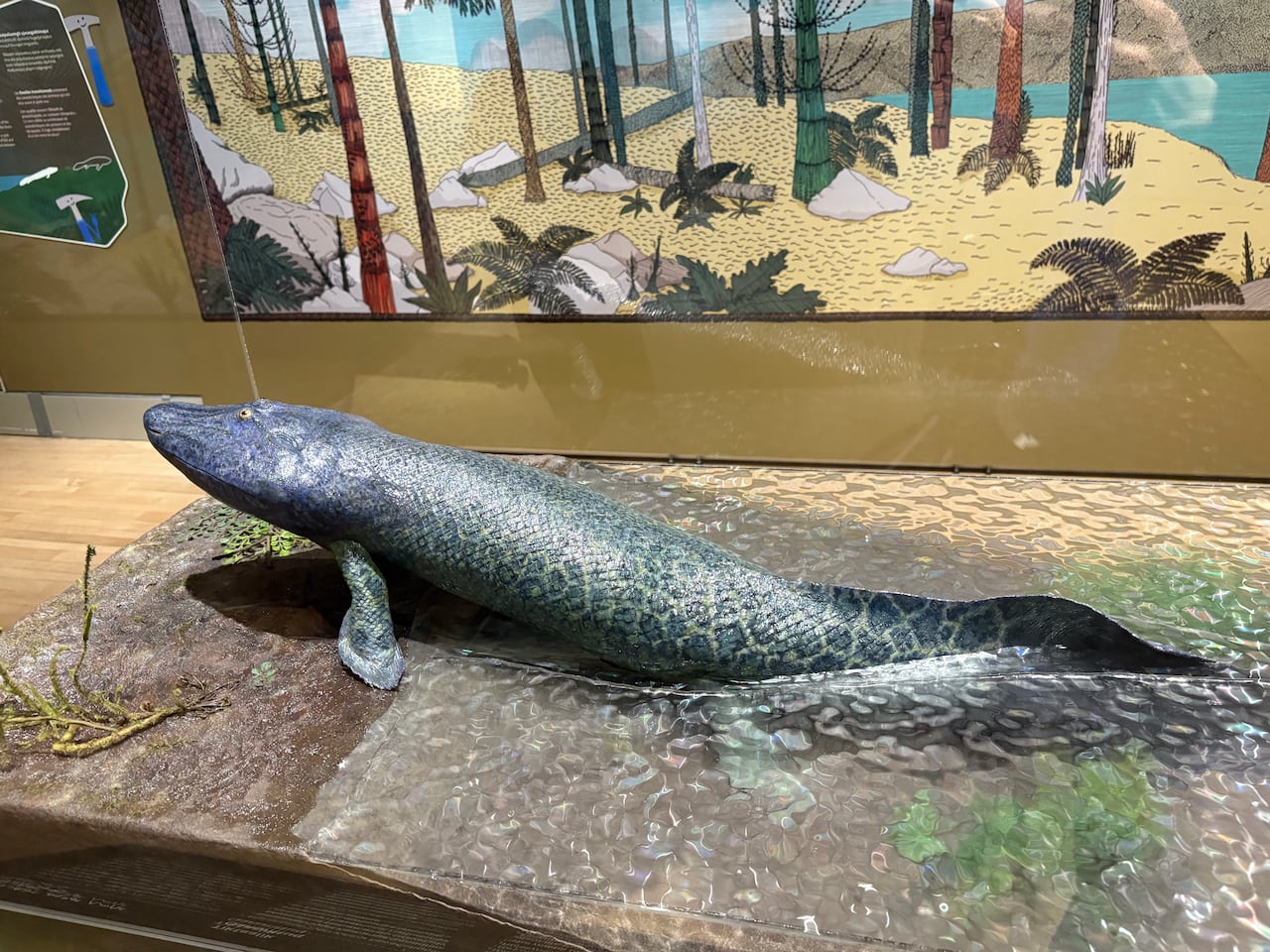
A modern recreation of Tiktaalik roseae at the Canadian Museum of Nature in Ottawa. This prehistoric tetrapod is considered the earliest species to have developed a neck. (Liam Baker/CBC)
“There is an evolutionary factor driving the separation of the shoulder girdle and the skull … if the advantage isn’t related to head movement, what could be the evolutionary rationale for this?” Korneisel pondered.
“What aligns most closely with existing data from other studies is that the pectoral girdle and forelimb were being utilized for new types of movement and novel locomotion patterns.”
The researchers conclude in their latest study that the low neck mobility observed in early tetrapods likely favored more efficient swimming and supported shoulder movements in the forelimbs.
A connection to human evolution
Although the study suggests a possible alternative explanation for the reason tetrapods first developed necks, Korneisel expresses her intention to conduct tests on other well-preserved early fish in the near future. She believes such investigations could yield deeper insights into how Tiktaalik roseae and its contemporaries moved throughout their bodies.
Maddin asserts that the findings also offer valuable perspectives on human evolution.
-
Nunavut’s ancient Qikiqtania fish fossil helps shed new light on evolution
-
Video
Arctic fossil unveiled at nature museum
“Considering the state of life on Earth during this period, vertebrates were quite scarce, representing the group of animals to which we belong. Thus, this marks a significant step in the evolution of our lineage and essentially all land-dwelling vertebrates,” Maddin remarked.
Tag: rewrite-pending
