
Many developments have occurred in New Brunswick during the 12 years since the shale gas exploration moratorium was enacted.
However, one fact remains unchanged: the resources beneath our land.
It is known that shale gas is contained within the underground rock layers.
The provincial government of New Brunswick estimates there are 77 trillion cubic feet of shale gas located in two identified gas fields. In contrast, Alberta, a much larger province, holds approximately 3,455 trillion cubic feet.
In the southern part of New Brunswick, the McCully Field, situated near Sussex, contains an estimated 67.3 trillion cubic feet of gas, while the Stoney Creek Field, located northeast near Hillsborough, has an additional 10.9 trillion cubic feet.
What led to its formation?
Shale, the type of rock that has the potential to contain gas, is prevalent across much of the province, extending from Bathurst to Fredericton and further east to Sackville.
To understand how gas became trapped in the shale, we must look back 350 million years to the Carboniferous period, which presented a vastly different landscape than what we see today in New Brunswick.
“During that era, southern New Brunswick was characterized by a vast marine environment,” explained Denis Lavoie, a retired geologist with three decades of experience at Natural Resources Canada.

Not every shale rock contains gas; geologist Denis Lavoie noted that the shale in New Brunswick capable of holding gas is primarily found in the southeast. (CBC)
According to Lavoie, the extensive ocean that once covered southern New Brunswick was home to numerous small organisms.
Upon their death, these organisms sank to the ocean floor, and over millions of years, formed a layer that was subsequently buried beneath hundreds of meters of rock.
“The organic material is then converted into hydrocarbons due to the increased temperature,” Lavoie stated.
In the context of New Brunswick, the desired hydrocarbon is natural gas.
What is the estimated quantity?
Having established that shale gas exists within the shale, the next inquiry is the volume of shale gas that is contained within it.
Over ten years after the moratorium on shale gas development was enacted by Brian Gallant’s Liberal government, a different Liberal administration is considering its termination.
As for the answer, Dave Keighley, a professor in the Earth Sciences department at the University of New Brunswick in Fredericton, offers a straightforward response: we simply do not know.
“The only way to determine this is to dig or drill,” Keighley stated.
This does not imply that efforts have not been made to gather more data regarding the potential gas reserves.
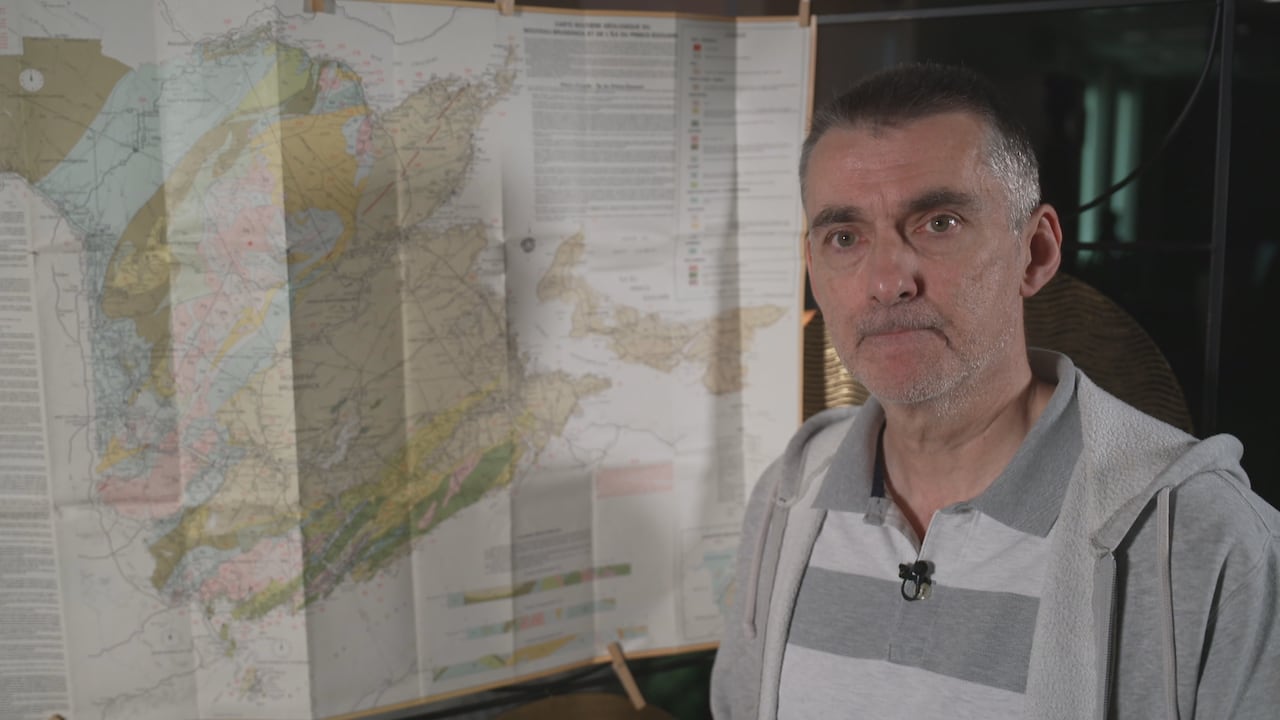
UNB geologist Dave Keighley highlighted that while estimates may provide some insight into gas volumes, actual knowledge can only be obtained through drilling. (Aniekan Etuhube/CBC)
Prior to the moratorium, several seismic surveys were conducted across different areas of the province.
Keighley mentioned that this information can give an indication of both the shale volume and the depth of the rock.
It is also feasible to estimate the potential gas volume that the rock may hold; however, without drilling, the exact amounts remain uncertain.
These estimates are merely approximations.
According to Keighley, estimates for New Brunswick, adhering to the most optimistic standards, suggest a likelihood of 10 to 50 percent for shale gas presence in those regions.

What exactly is shale gas? Where is it located in the province? Dave Keighley is a professor at the University of New Brunswick in Fredericton.
“That represents the most favorable scenario; however, the truth is we remain uncertain,” Keighley indicated.
Lavoie emphasized the importance of recognizing that the presence of shale rock does not guarantee the existence of shale gas.
“In some locations, shale exists, but it may not have been buried sufficiently deep for the organic material to undergo transformation, hence hydrocarbons are absent,” Lavoie explained.
“It is crucial to understand the quantity of organic matter present in the rock and the depth at which these rocks lie.”
Lavoie believes that southeastern New Brunswick offers the best prospects for shale gas, given that the rocks are younger and possess a greater chance of containing the organic matter required to yield hydrocarbons.
In the central and northern regions, the rocks are older and contain less organic material, significantly reducing the likelihood of substantial gas reserves to a “minimal” level.
This article is part of the series Shale Gas Development Revisited: What’s Changed. CBC New Brunswick is examining the shifts that have occurred since the provincial government enacted a moratorium on shale gas exploration in 2014. The government will review the moratorium until January 2027, at which point a decision will be made regarding its potential lifting. If you have a story or tip to share on this topic, please write: nbshalegas@cbc.ca.
Tag: rewrite-pending
