
Several mountain national parks in Alberta are implementing watercraft restrictions due to the threat of aquatic invasive species (AIS), leading to concerns among paddlers who are advocating for a more cooperative approach to address the issue.
Beginning this spring, lakes and rivers in Jasper National Park, along with Banff, Yoho, Kootenay, and Waterton Lakes, will be divided into three zones with varying regulations for water activities. While certain popular water bodies remain accessible to paddlers, the restrictions primarily impact backcountry areas.
Expressing disappointment over the new rules, Andrew Loughlin, a seasoned whitewater enthusiast based in Jasper for over two decades, described the restrictions as disheartening in a letter he sent to Parks Canada. He highlighted that many of the park’s cherished locations are only accessible by boat.
Loughlin estimated that more than 75% of the navigable waterways in Jasper are now restricted.
Presence of Whirling Disease in Lake Louise
The decision to introduce these measures follows the recent confirmation of whirling disease in Lake Louise. Parks Canada attributes this occurrence to human activities on the lake, stating that the disease affects young fish species like salmon, whitefish, and trout by causing skeletal deformities and potentially decimating up to 90% of juvenile fish populations.
Whirling disease was initially identified in British Columbia in 2024 and later spread to the Kootenay River watershed, although it has not been detected in Kootenay National Park.
Emphasizing the urgency to prevent further spread, Dave Argument, a resource conservation manager at Parks Canada, stressed the importance of immediate action to contain the disease and reduce its transmission risks.
According to Argument, once invasive species and diseases infiltrate water bodies, their eradication becomes challenging, and they can easily spread downstream. Parks Canada points out that AIS primarily propagate through watercraft and fishing gear transferred between different lakes and rivers.
Argument clarified that the decision to enforce restrictions was made after thorough evaluations of each watershed to safeguard aquatic ecosystems while maintaining safe recreational opportunities wherever feasible.
Accessibility Status of Waterways
While the primary stem of the Athabasca River remains open for recreational activities, the secondary channels, characterized by more challenging rapids ranging from Class 4 to Class 5, are predominantly off-limits to watercraft, fishing waders, and windsports.
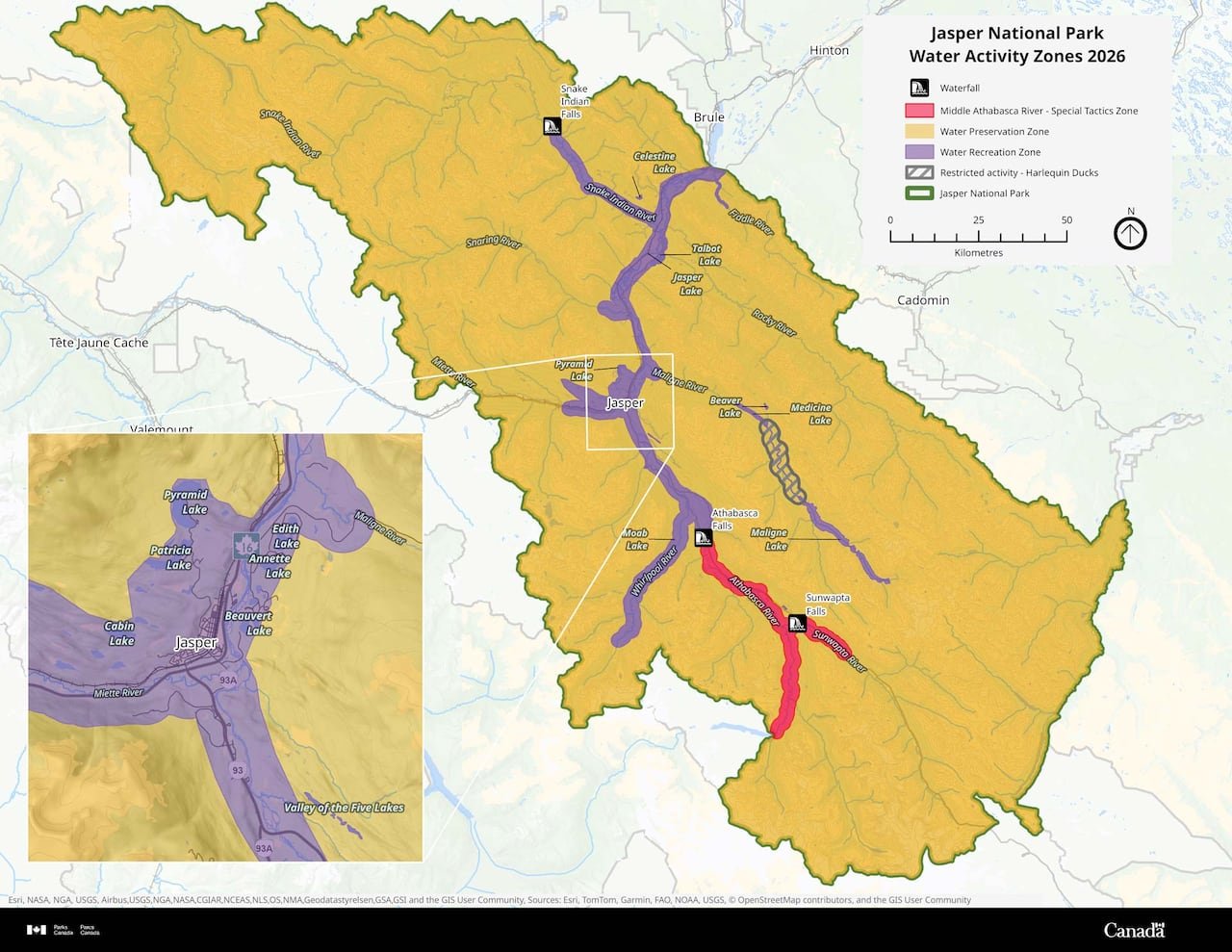
Some rivers continue to be accessible to paddlers due to natural barriers like waterfalls that prevent AIS from moving upstream. In the designated water recreation zone, scuba diving is allowed under licensed commercial operators.
Specific sections of the Athabasca River, Chaba River, and Sunwapta River fall under the “special tactics zone,” prohibiting fishing with waders only.
Even in restricted areas, activities like swimming, beach toys, snorkelling, and fishing without waders or wading boots are still permitted.
For a comprehensive list of open and closed areas, visitors can refer to <a href="https://parks.canada.ca/p
