
Researchers from the University of Alberta have identified the remains of a dinosaur skull discovered in a British Columbia campground as belonging to a lighter and faster tyrannosaur species than the well-known T. rex.
The study, published in Palaeogeography, Palaeoclimatology, Palaeoecology, revealed that the partial skull impression found about 76 million years ago is from a horned dinosaur called Gorgosaurus, providing new insights into the ancient species that once roamed Western Canada, according to lead author Colton Coppock.
The Royal Tyrrell Museum in Alberta estimates that the Gorgosaurus species could grow up to nine meters in length.
Discovery near the river
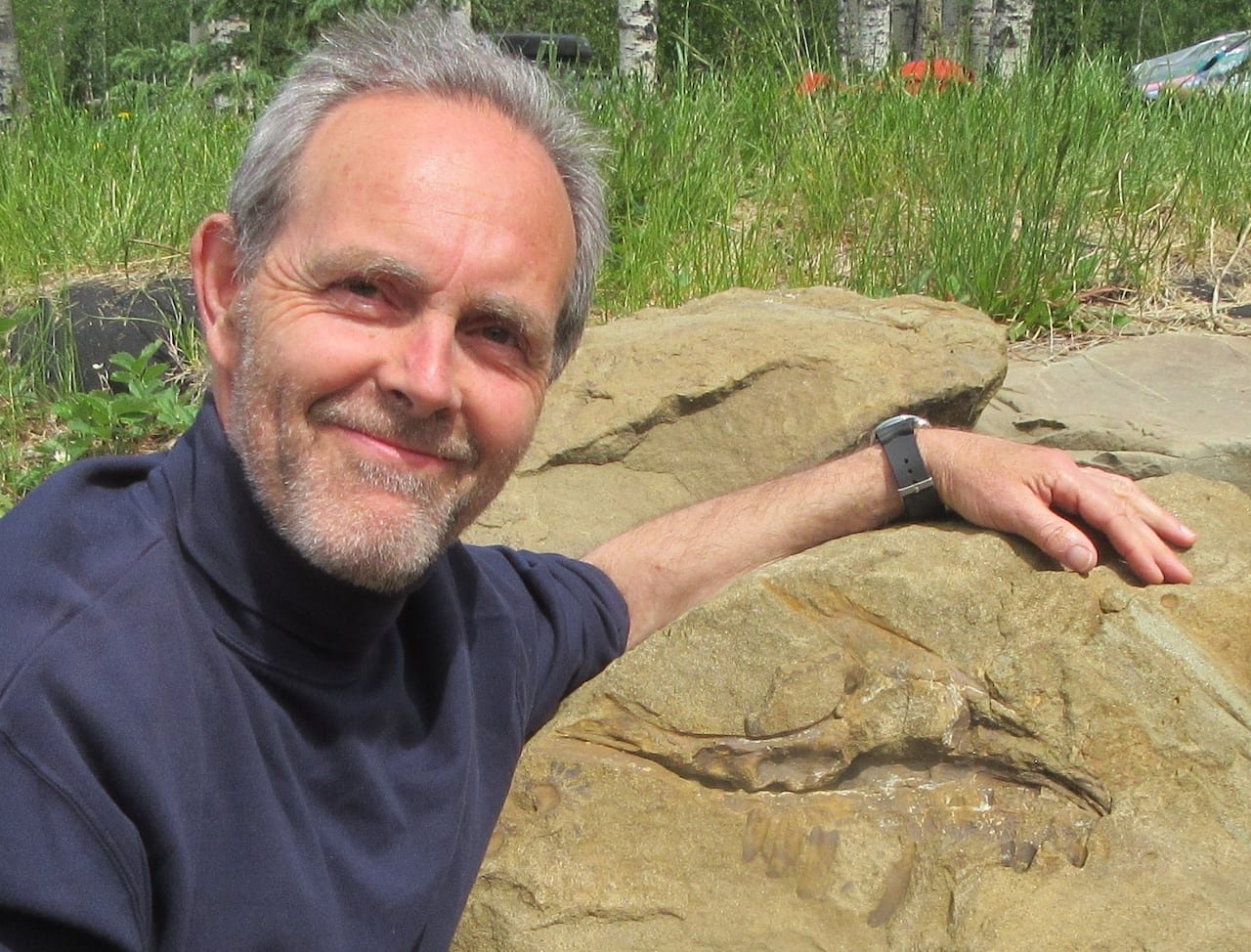
The journey to identify the dinosaur began in 2017 when Rick Lambert, a resident of British Columbia, stumbled upon an unusual rock at a Tumbler Ridge campground, near the Alberta border. Lambert, who had a childhood passion for fossil hunting, credited a squirrel for directing him to the rock along the river’s edge.
Upon examination by a paleontologist from the Tumbler Ridge Museum Foundation, it was confirmed that Lambert had found the first tyrannosaurus skull ever discovered in British Columbia.
Eamon Drysdale, the museum’s curator, noted that while there is abundant dinosaur material in the region, bone material is scarce. The original impression of the skull, preserved in a sandstone block, is carefully protected under controlled environmental conditions.
Preserved details
The partial skull imprint revealed the maxilla, the upper jaw of the dinosaur. Despite erosion of most of the actual bone, the impression was well-preserved, enabling researchers to create a detailed cast that showcased the unique features of the skull.
Colton Coppock recalled that his supervisor presented the cast at a barbecue last August, and he immediately recognized it as likely belonging to Gorgosaurus libratus, a species that existed 76 million years ago, predating the T. rex by 10 million years.
Describing Gorgosaurus, Coppock mentioned its triangular horns above the eyes, distinguishing it from the T. rex. He likened Gorgosaurus to a faster and more lightly built relative of the T. rex.
The detailed cast allowed researchers to examine the internal surface of the maxilla and compare it to more complete Gorgosaurus skull bones, providing valuable insights into the ancient species.
Gorgosaurus, one of the most extensively documented tyrannosaurs in Alberta, was among the first dinosaurs found in the province’s Dinosaur Park Formation, offering researchers a rich source of information.
Insights from the past
Analysis of bone sutures in the nasal area and a bone rod separating openings in the upper jaw supported the link between the partial skull and Gorgosaurus. The teeth of the dinosaur indicated that it was likely a juvenile at the time of death.
Colton Coppock shared that their research revealed the species had a wider range than previously thought, similar to the territory covered by grizzly bears and cougars today, spanning approximately 198,000 square kilometers from northern British Columbia to northern Montana.
Highlighting Lambert’s discovery as a sign of potential future dinosaur finds in British Columbia, Coppock emphasized the region’s emerging significance in dinosaur research.
For Lambert, the fossil discovery held a deeper meaning, symbolizing the enduring history of life on Earth. “We live in an amazing place where things that have lived, have lived for so long. That is an incredible thing,” he reflected.
Tag: rewrite-pending
